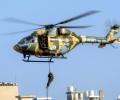
'The tools of warfare are changing. The MoD must deepen its engagement with technology thinkers that can present compelling visions of where warfare may be heading.'

A senior Pakistani defence official, Lt Gen (retd) Mazhar Jamil, claimed that India's long-range missile development indicates ambitions to become a global nuclear power capable of threatening Western capitals, urging international attention to India's military modernisation. He also reiterated Pakistan's commitment to deterrence stability in South Asia.

An Indian Army contingent, Navy warships INS Tarkash and INS Ikshak, and a naval band are participating in Seychelles' Golden Jubilee National Day celebrations. Prime Minister Narendra Modi is attending as the Guest of Honour, underscoring the strong strategic partnership and defence cooperation between India and the archipelago nation.

Defence Minister Rajnath Singh on Sunday slammed Pakistan for making terrorism a "part of its state policy", and said there will be no talks with the country other than on Pakistan-Occupied-Kashmir, which is a "part of India illegally occupied" by it.

The Indian military will showcase an Operation Sindoor-themed tableau for the Republic Day parade, highlighting the jointness of the three services and India's military capabilities.

Merlinhawk Aerospace has partnered with Boeing India Defence to provide in-country maintenance, repair, and lifecycle support for advanced Electro-Optical/Infrared (EO/IR) systems on Indian military platforms. This collaboration aims to strengthen local support, reduce turnaround times, and enhance mission readiness for the Indian Navy, aligning with India's self-reliance goals in defence.
Merlinhawk Aerospace has partnered with Boeing India Defence to provide in-country maintenance, repair, and lifecycle support for advanced Electro-Optical/Infrared (EO/IR) systems on Indian military platforms. This collaboration aims to strengthen local support, reduce turnaround times, and enhance mission readiness for the Indian Navy, aligning with India's self-reliance goals in defence.

Former US President Donald Trump reiterated his claim of mediating the India-Pakistan conflict, stating that 11 jets were shot down during the May 2023 hostilities. He also suggested the conflict could have escalated to a nuclear level and claimed credit for averting a major catastrophe, a claim consistently denied by India which maintains no third-party intervention occurred.

India's defence expenditure surged to $92.1 billion in 2025, making it the world's fifth-largest military spender, according to SIPRI data. This 8.9 per cent year-on-year rise was primarily driven by operational and procurement needs following heightened regional tensions with Pakistan in May 2025.

More than a quarter of a century after Indian Army soldier Avnish Yadav laid down his life in the Kargil War defending the nation, his family said that several promises made by the authorities in recognition of his sacrifice are yet to be fulfilled.

Europe has overtaken Asia as India's biggest arms supplier, reflecting New Delhi's evolving defence procurement strategy.

US Secretary of War Pete Hegseth praised India's military modernisation efforts at the Shangri-La Dialogue in Singapore, highlighting its growing industrial and logistics capacity.

India has lodged a 'strong protest' with Iran over recent strikes on commercial vessels in the Strait of Hormuz, which resulted in the death of one Indian sailor and injuries to several others, calling for an immediate cessation of hostilities and a return to diplomatic engagement.

India has successfully evacuated 59 vessels, including 23 Indian-flagged and 36 foreign-flagged ships carrying cargo for India, from the Strait of Hormuz since March 1, 2026, amid fresh attacks and declining shipping traffic, Shipping Minister Sarbananda Sonowal informed the Rajya Sabha.

Foreign Secretary Vikram Misri stated that the Indian government has no involvement or official support for Track 2 discussions on India-Pakistan ties, even when retired Indian officials participate. He clarified that such participants speak in their personal capacities and do not represent the government's views, and New Delhi does not take cognisance of these private events.

India has advised its nationals to postpone travel to Iran and urged those already there to consider leaving due to increasing instability and conflict in the region. The advisory from the Indian Embassy in Tehran highlights heightened caution and the need to monitor the security situation.

'Energy prices would shoot up with the closure of Hormuz again.'

India is navigating a complex diplomatic landscape, attempting to balance its 'forever honeymoon' with the Israel-UAE-Bahrain axis against its historical ties with Iran, as evidenced by recent high-level visits and evolving geopolitical realignments in the Middle East, observes Ambassador M K Bhadrakumar.

A lesson for India is to clearly define objectives beforehand, so that the adversary or other parties do not attempt to mitigate them midway.

The harsh truth is that the US is no longer a reliable partner, cautions Ramesh Menon.

Indian benchmark indices Sensex and Nifty saw a significant rebound in early trade, driven by a sharp decline in crude oil prices and easing geopolitical tensions in the West Asia, which improved market sentiment and reduced inflation fears. Track Sensex, Nifty on July 27.

Lachit Borphukan is revered as one of Assam's greatest military commanders and a symbol of courage, patriotism and selfless leadership.

It is an unusual choice to depute a retired general for the funeral of a revered religious figure but a thoughtful one in an attempt to inject verve into the bilateral relationship and restore the equilibrium in India's West Asian policies, notes Ambassador M K Bhadrakumar.

The arms trade surplus grew tenfold, reaching $691 million in FY26 from $63 million in FY18.

A new report from the Stockholm International Peace Research Institute (SIPRI) indicates that India has expanded its nuclear arsenal and is developing long-range weapons capable of reaching targets across China, while also maintaining focus on its rivalry with Pakistan.

India has reiterated its support for freedom of navigation and unimpeded commerce in the South China Sea, backing a 2016 international arbitral tribunal ruling that rejected China's extensive territorial claims. This stance aligns with a recent joint statement by the US, UK, and other nations, emphasising peaceful resolution of maritime disputes under UNCLOS.

The Supreme Court has agreed to hear a plea from Uttar Pradesh police challenging a Bombay High Court ruling that absolved BrahMos Aerospace engineer Nishant Agarwal of major espionage charges under the Official Secrets Act. Agarwal was previously sentenced to life imprisonment by a Nagpur district court for spying for Pakistan's ISI, despite the High Court finding he only illegally stored sensitive data.

To get its act going in Myanmar, India would need very dynamic diplomacy and not the lazy all-eggs-in-one-basket approach, points out Subir Bhaumik.

Joe Root anchored England's chase with an unbeaten 99 as the hosts defeated India by four wickets in the second ODI to level the three-match series in Cardiff on Thursday.
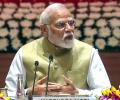
Prime Minister Narendra Modi, in his 'Mann Ki Baat' broadcast, highlighted India's recent achievements in self-reliance, including the maiden flight of the made-in-India C-295 aircraft and the induction of indigenous naval ships. He also lauded the global participation in International Yoga Day and India's success at the World Yoga Asana Championship, alongside Nalanda University's revival of the 'Shastrarth' tradition.

Prime Minister Narendra Modi addressed the Indonesian parliament, emphasising India's commitment to development over expansionism and advocating for a free, open, and inclusive Indo-Pacific. He highlighted the strong historical ties between India and Indonesia, calling for enhanced cooperation in various sectors, including defence, technology, and counter-terrorism, amidst growing concerns over regional security.

Prime Minister Narendra Modi and Indonesian President Prabowo Subianto have significantly advanced the India-Indonesia Comprehensive Strategic Partnership, securing crucial agreements on defence, critical minerals, and maritime security, including BrahMos missile supply and Sabang port development.

Successful interceptor, anti-ship, MIRV and hypersonic technology tests have strengthened India's position among a select group of advanced missile powers.

Defence Minister Rajnath Singh stated that the "intent of infiltrators" remains unchanged since the 1999 Kargil conflict, but assured that the Indian Army is "fully prepared" to meet any such challenges, emphasising the government's focus on armed forces modernisation.

The US has warned India that any violation of its naval blockade in the Strait of Hormuz and illicit transport of Iranian oil will not be tolerated, a statement made amidst a diplomatic row over the deaths of Indian seafarers in US attacks on commercial vessels off the coast of Oman.
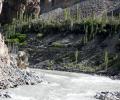
Pakistan's military leadership has committed to securing the country's "rightful share" of water under the Indus Water Treaty, following India's actions post-Pahalgam attack. The military also expressed concerns over militant activities from Afghan territory and reaffirmed support for Kashmiris, vowing continued operations against terrorism.

External Affairs Minister S Jaishankar met his Chinese counterpart Wang Yi in Manila, reiterating that peace and tranquillity in border areas are prerequisites for normal India-China relations. He stressed the importance of mutual respect, interest, and sensitivity, while also raising concerns about market access, trade imbalance, and supply chain uncertainties.

Gwadar is viewed as a critical pearl in China's maritime strategy as it would give a permanent logistical footprint near an important choke point - the Strait of Hormuz and the oil rich Persian Gulf, explains Commodore Venugopal Menon (retd).

National Security Adviser Ajit Doval held "constructive" talks with Chinese Foreign Minister Wang Yi in New Delhi, focusing on the normalisation of bilateral ties. The discussions reviewed recent developments and progress towards rebuilding trust after the eastern Ladakh border standoff. Both sides have implemented measures, including disengagement pacts and high-level meetings, to improve relations.

History may remember Takaichi Sanae not as the leader who simply accelerated Japanese rearmament, but as one who governed during Japan's transition from an industrial-age security model to a post-industrial strategic member of the global order, points out Varun Arya.
